

Official Soccer Field Dimensions Guide (FIFA/NCAA/High School)
Nov 23, 2024
Leave a message
This page provides a comprehensive guide to official soccer field dimensions for FIFA, NCAA, and high school levels.
In the United States, soccer fields are categorized into youth, adult, and professional playing fields, with standards for each type of field size. These dimensional sizes are usually designed according to the regulations of the United States Soccer Association (US Soccer) and FIFA.
The different sizes of fields are set up to ensure the popularity and growth of the game of soccer, so that players at all levels can exercise and play in the right environment. If a field does not meet the regulations, it can lead to the cancellation or rescheduling of matches, and even affect the performance and safety of the players. Next, we'll take an in-depth look at soccer field dimensions categorized by age group and team size.
Official soccer field size requirements
FIFA (soccer's global governing body) recommend that soccer field sizes should vary depending on the age of the participants, skill level, and nature of the game.
Youth soccer field sizes vary depending on the age group. Smaller fields help beginners to better master basic skills, while larger fields are suitable for high-level competitive matches and can provide space for more complex tactics.
The size of a soccer field
The size of a soccer field varies depending on the level of play and rules. Generally, a standard soccer field is between 100 and 120 yards long and 55 to 80 yards wide. These dimensions ensure that the game is fluid and enjoyable to watch. Of course, different organizations and leagues may have specific requirements, such as the International Federation of Association Football (IFAB) and the National Federation of High School Athletics (NFHS), which have their own standards.
Youth Soccer Field Size Chart
|
US Youth Soccer - Youth Soccer Soccer Field Sizes |
|||||||
|
|
Number of Players |
Soccer Field Length (Yards) |
Soccer Field Width (Yards) |
||||
|
Age Group |
Number of Players |
Length (Yards) |
Length (Meters) |
Length (Feet) |
Width (Yards) |
Width (Meters) |
Width (Feet) |
|
Under 6 |
3v3 or 4v4 |
25-35 |
22.9-32.0 |
75-105 |
15-25 |
13.7-22.9 |
45-75 |
|
Under 7 and Under 8 |
4v4 or 5v5 |
25-35 |
22.9-32.0 |
75-105 |
15-25 |
13.7-22.9 |
45-75 |
|
Under 9 and Under 10 |
6v6 or 7v7 |
55-65 |
50.3-59.4 |
165-195 |
35-45 |
32.0-41.1 |
105-135 |
|
Under 11 and Under 12 |
8v8 to 11v11 |
70-80 |
64.0-73.15 |
210-240 |
45-55 |
41.1-50.3 |
135-165 |
|
Under 13 |
11v11 |
100-130 |
91.4-118.9 |
300-390 |
50-100 |
45.7-91.4 |
150-300 |
For more detailed information on youth soccer rules, click here to download "Youth Soccer Rules".
Soccer field and equipment requirements for all age groups
Under 7 to Under 8 Soccer Pitches
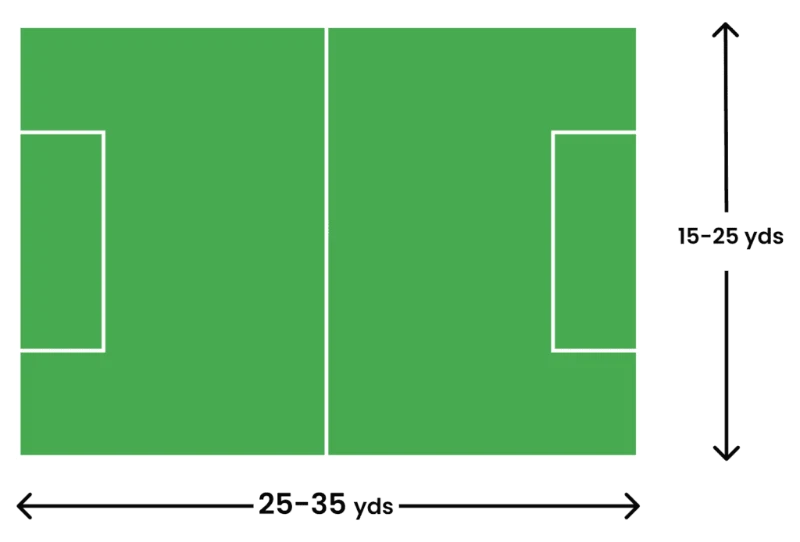
Official Regulations for Soccer Field Dimensions for Children Aged 7 to 8 by the U.S. Youth Soccer Association:
In yards: Length requirement is 25-35 yards, width requirement is 15-25 yards.
In meters: Length requirement is 22.9-32.0 meters, width requirement is 13.7-22.9 meters.
In feet: Length requirement is 75-105 feet, width requirement is 45-75 feet.
Goal dimensions: Length requirement is 6.5 feet, width requirement is 18.5 feet.
The match duration is typically 50 minutes with no extra time. Each team consists of 4 players, and there is no designated goalkeeper. The halftime break lasts for 5 minutes, allowing players to rest and regroup before the second half of the match.
Under 9 and Under 10 Soccer Pitches
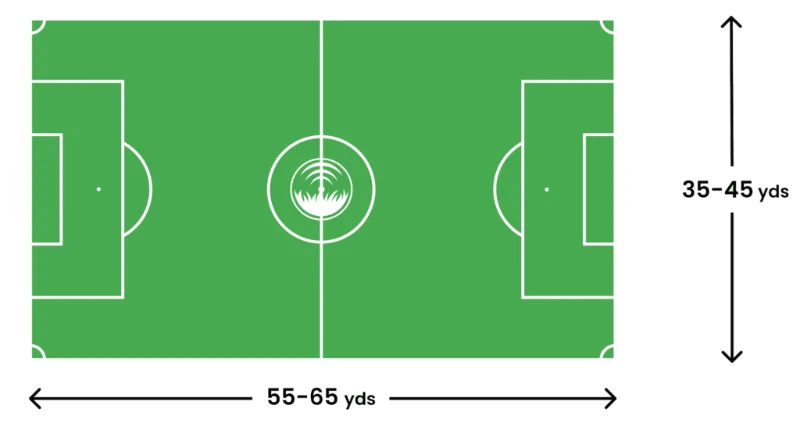
Official Regulations for Soccer Field Dimensions for Children Aged 9 and Under and 10 and Under by the U.S. Youth Soccer Association:
In yards: Length requirement is 60-70 yards, width requirement is 40-50 yards.
In meters: Length requirement is 54.9-64.0 meters, width requirement is 36.6-45.7 meters.
In feet: Length requirement is 180-210 feet, width requirement is 120-150 feet.
Goal dimensions: Length requirement is 6.5 feet, width requirement is 18.5 feet.
The match duration is typically 50 minutes, with no extra time. Each team consists of 7 players, including a designated goalkeeper. The halftime break lasts for 5 minutes, allowing players brief rest and regrouping time.
Under 11 to Under 12 Soccer Pitches

Official Regulations for Soccer Field Dimensions for Children Aged 11 to 12 by the U.S. Youth Soccer Association:
In yards: Length requirement is 70-80 yards, width requirement is 45-55 yards.
In meters: Length requirement is 64.0-73.15 meters, width requirement is 41.1-50.3 meters.
In feet: Length requirement is 210-240 feet, width requirement is 135-165 feet.
Goal dimensions: Length requirement is 7 feet, width requirement is 21 feet.
The match duration is typically 60 minutes with no extra time. Each team consists of 8 players, and there is a designated goalkeeper. The halftime break lasts for 10 minutes, providing players with time to rest and strategize for the second half of the match.
Under 13 to Under 14 Soccer Pitches
Official Regulations for Soccer Field Dimensions for Children Aged 13 to 14 by the U.S. Youth Soccer Association:
In yards: Length requirement is 100-130 yards, width requirement is 50-100 yards.
In meters: Length requirement is 91.4-118.9 meters, width requirement is 45.7-91.4 meters.
In feet: Length requirement is 300-390 feet, width requirement is 150-300 feet.
Goal dimensions: Length requirement is 8 feet, width requirement is 24 feet.
The match duration is typically 70 minutes, with a halftime break of 10 minutes. There is no extra time, and each team consists of 11 players with a designated goalkeeper. Mixed-gender teams are allowed, promoting inclusivity in the sport.
Under 15 to Under 16 Soccer Pitches
Official Regulations for Soccer Field Dimensions for Children Aged 15 to 16 by the U.S. Youth Soccer Association:
In yards: Length requirement is 100-130 yards, width requirement is 50-100 yards.
In meters: Length requirement is 91.4-118.9 meters, width requirement is 45.7-91.4 meters.
In feet: Length requirement is 300-390 feet, width requirement is 150-300 feet.
Goal dimensions: Length requirement is 8 feet, width requirement is 24 feet.
The match duration is typically 80 minutes, with a halftime break of 10 minutes. There may be extra time if necessary, and each team consists of 11 players with a designated goalkeeper. Mixed-gender teams are permitted, fostering inclusivity in youth soccer.
Under-17 and above soccer pitches
Official Regulations for Soccer Field Dimensions for Ages 17 and Older by the U.S. Youth Soccer Association:
In yards: Length requirement is 110-120 yards, width requirement is 70-80 yards.
In meters: Length requirement is 100.6-109.7 meters, width requirement is 64.0-73.2 meters.
In feet: Length requirement is 330-360 feet, width requirement is 210-240 feet.
Goal dimensions: Length requirement is 8 feet, width requirement is 24 feet.
The match duration is typically 90 minutes, with a halftime break of 15 minutes. There may be extra time if necessary, and each team consists of 11 players with a designated goalkeeper. Mixed-gender teams are not typically allowed at this level, focusing on competitive play.
For more detailed information on youth soccer information, you can refer to the website "FIFA Youth Soccer Information".
High school football field size
High school is an important foundation for becoming a professional player, but it takes more sweat and effort to become a professional player.
High school football field size.
High school soccer field dimensions in the U.S. are set by the National Federation of State High School Associations (NFHS).
Dimensions:
In yards: Length requirements are 110-120 yards, Width requirements are 70-80 yards.
In meters: Length requirements are 100-110 meters, Width requirements are 64-75 meters.
In feet: Length requirements are 328-360 feet, Width requirements are 210-246 feet.
Goal dimensions: Length requirements are 8 feet, Width requirements are 24 feet.
For other countries, high school soccer field dimensions are set by the International Football Association (FIFA).
Dimensions:
In yards: Length requirements are 110-120 yards, Width requirements are 70-80 yards.
In meters: Length requirements are 100-110 meters, Width requirements are 64-75 meters.
In feet: Length requirements are 328-360 feet, Width requirements are 210-246 feet.
Goal dimensions: Length requirements are 8 feet, Width requirements are 24 feet.
In contrast to elementary and middle school football rules, middle school games use standard field sizes, longer game times, and introduce more complex strategies and rules, reflecting the development of players and the increasing competitiveness of the sport.
College football field dimensions
High school soccer field dimensions in the U.S. are set by the NCAA.
Dimensions:
In yards: Length requirements are 110-120 yards, Width requirements are 70-80 yards.
In meters: Length requirements are 100-110 meters, Width requirements are 64-75 meters.
In feet: Length requirements are 328-360 feet, Width requirements are 210-246 feet.
Goal dimensions: Length requirements are 8 feet, Width requirements are 24 feet.
For more detailed information about the NCAA, you can refer to the website "NCAA Football Field Rules".
For other countries, high school soccer field dimensions are set by the International Football Association (FIFA).
Dimensions:
In yards: Length requirements are 110-120 yards, Width requirements are 70-80 yards.
In meters: Length requirements are 100-110 meters, Width requirements are 64-75 meters.
In feet: Length requirements are 328-360 feet, Width requirements are 210-246 feet.
Goal dimensions: Length requirements are 8 feet, Width requirements are 24 feet.
The primary differences between college soccer rules and high school rules include game duration, substitution rules, and officiating standards. College matches are typically longer, consisting of two 45-minute halves, compared to high school's two 40-minute halves. These factors collectively enhance the level of play and tactical complexity in college soccer.
How big is a soccer field for hosting international matches?
According to FIFA regulations, the length range of a field for international matches should be 110 to 120 yards and the width should be 70 to 80 yards. This standard ensures fairness and consistency of play.
In practice, the most commonly used size is approximately 110 meters long and 75 meters wide. The advantage of this size is that it provides players with enough space for offense and defense, encourages quick passing and running, and also ensures the flow of the game. Appropriate field dimensions help to maintain the tension and spectacle of the game and enable spectators to better experience the intensity of the game.
Dimensions of Famous Soccer Stadiums
Knowing the dimensions of the world famous soccer stadiums is crucial for soccer fans and professionals, here are the dimensional data of some of the top stadiums for reference:
| Club | Stadium | Location | Length (yards) | Width (yards) | Notable Events | Artificial Grass |
| Manchester United | Old Trafford | Manchester (UK) | 114.8 | 74.4 | English Premier League, UEFA Champions League | No |
| Liverpool | Anfield | Liverpool (UK) | 110.5 | 74.4 | English Premier League, UEFA Champions League | No |
| Wrexham | Racecourse Ground | Wrexham (UK) | 111.5 | 74.4 | - | No |
| Wembley | Wembley Stadium | London (UK) | 115 | 75 | FA Cup, UEFA Champions League Finals | No |
| LA Galaxy | Dignity Health Sports Park | California (USA) | 120 | 75 | MLS, International Friendlies | No |
| D.C. United | Audi Field | Washington, D.C. (USA) | 115 | 75 | MLS | No |
| Real Madrid | Santiago Bernabeu Stadium | Madrid (Spain) | 114.8 | 74.4 | La Liga, UEFA Champions League | Yes,natural and artificial grass hybrid systems |
| FC Barcelona | Camp Nou | Barcelona (Spain) | 115.02 | 74.47 | La Liga, UEFA Champions League | Yes,natural and artificial grass hybrid systems |
| Borussia Mönchengladbach | Borussia-Park | Mönchengladbach (Germany) | 121.29 | 78.65 | Bundesliga | Yes,natural and artificial grass hybrid systems |
| Hamburg | Volksparkstadion | Hamburg (Germany) | 115.02 | 74.47 | Bundesliga |
Yes,natural and artificial grass hybrid systems |
Components of a soccer field
Center circle:
The center circle is a circular area in the center of a soccer field used for kickoffs to start a game or second half. It has a diameter of 10 yards (about 9.15 meters) and ensures fair play, as all players must be outside the center circle at kickoff.
Center Line:
The center line is a vertical line on a soccer field that divides the field into two equal halves. It extends from one side of the boundary to the other, ensuring symmetry of play and helping the referee and players to determine offside.
Penalty area (penalty box):
The penalty area, sometimes called the "box", is a rectangular area located in front of each goal. The penalty area is 18 yards (16.46 m) long and 44 yards (40.26 m) wide from the center of the goal line, determined by measuring 18 yards on each side of the goalposts, including the width of the goal (usually 8 yards or 7.32 m).
Corner Arc:
The corner arc is located near the corner flags at each corner of the pitch and is a quarter circle with a radius of 1 yard (about 0.91 meters). When the ball is kicked out of bounds, a corner kick is taken from the corner arc, which is a way for the attacking team to regain possession of the ball.
Goal area (penalty area):
The goal area is a smaller rectangular area located in front of the goal to protect the goalkeeper from interference when serving a goal kick. The goal area is 6 yards (5.49 m) from the goal line, 18 yards (16.46 m) wide and 5.5 yards (5.03 m) long.
Goals:
The goals are located at each end of the field and are contested by both sides of the game. Goals are 8 feet (about 2.44 meters) high and 8 yards (about 7.32 meters) wide. Goals must be strong and stable to ensure safe and fair play.
Sidelines:
Sidelines are the two horizontal lines of a soccer field that define the width of the field. They extend from the corner flags at one end to the corner flags at the other, ensuring that the boundaries of the pitch are clear and helping referees and players to determine whether the ball is out of bounds.
5 Common Mistakes in Site Layouts (and How to Avoid Them)
Mistake 1: Inaccurate Field Dimensions
Many fields fail to follow strict standard dimensions when laying out a field, leading to problems during games. To avoid this mistake, make sure you know the standard dimensions of a soccer field before measuring and use accurate tools to do so. You can use a tape measure and measuring wheel to ensure that each boundary is in line and check the measurements several times to avoid errors that could affect the overall layout.
Mistake 2: Unclear markings
Unclear field markings can lead to confusion between players and referees during the game. To avoid this problem, markings should be made with sharp and durable materials, such as spray paint or high-quality marker ropes. When marking, make sure the lines are straight and of a consistent width, using a level to check if necessary. Also, maintain markers regularly to ensure they are always visible during play.
Mistake 3: Lack of proper drainage
Poor drainage can lead to waterlogging of the field, which can interfere with play. To avoid this problem, consider the terrain and drainage design when laying out the field. Choose an appropriate site location and ensure that there is sufficient slope for water to flow to the drains. Regularly check the effectiveness of the drainage system to ensure that the venue stays dry during rainy or wet weather to minimize the impact on the game.
Mistake 4: Neglecting safety areas
Many field layouts fail to allow for safety areas, which can lead to player injuries. To avoid this problem, sufficient open space should be left around the field to ensure that players have enough room to run and fall during the game. It is recommended to leave a safety area of at least two meters outside the boundaries to avoid accidents caused by the field boundaries being too close and to ensure the safety of the players.
Mistake 5: Improper Ground Maintenance
Improper pitch maintenance can lead to damaged and uneven turf, affecting the quality of play. To avoid this problem, perform regular turf mowing, fertilizing and watering to ensure the field stays in top condition. A maintenance program can be put in place to check the health of the turf weekly and deal with weeds and pests in a timely manner. In addition, regular field leveling is performed to ensure good conditions during games and to enhance the overall playing experience.
How to Measure a Soccer Field in 3 Steps (Using DIY Tools)
Step 1: Prepare your tools and materials
Before you start measuring your soccer field, make sure you have the necessary tools and materials. Common DIY tools include a tape measure, marker string, stakes or nails, chalk or spray paint, a level, and a measuring wheel.
A tape measure can be used to measure length and width, and marking rope can help you delineate the boundaries of your site. Choose an open area free of obstacles for accurate measurements.
Step 2: Measure the boundaries of the site
Use a tape measure or measuring wheel to begin measuring the boundaries of the soccer field.
Starting with one side corner, measure and mark the length and width of the field, making sure that these dimensions are in line with the standard. You can use stakes or nails to mark the position of each corner and use chalk or spray paint to draw the boundary lines on the ground. Make sure that the boundaries measured are straight lines so that you can ensure the symmetry of the field.
Also, use a level to check that the markings are straight and make sure that the four corners of the field are at right angles so that you get a standard soccer field.
Step 3: Delineate the center line and penalty area
Once the boundary measurements have been taken, the next step is to demarcate the center line and penalty area.
First, find the midpoint in the center of the field and draw a straight line to divide the field into two halves, making sure the length and width are symmetrical. Then, measure and mark the location of the penalty area according to the standard dimensions of a soccer field. Typically, the penalty area is 16.5 meters wide and 16.5 meters deep.
Clearly mark these zones on the ground with chalk or spray paint, making sure that all markings are accurate. This step will provide clear boundaries for subsequent games to run smoothly.
FAQ
Q: Why is a soccer field called a pitch?
A: The word "pitch" is derived from the Middle English word "pichen" meaning "to throw" or "to hurl", which is related to the action of throwing a ball in early soccer. "It is related to the action of throwing the ball in early soccer games.
Q: How many soccer players are on the field?
A: In a standard soccer game, each team has 11 players, including a goalkeeper.
Q: How many acres is a soccer field?
A: A standard soccer field is usually between 1.24 and 1.49 acres in size, depending on the length and width of the field.
Q: How big is a World Cup soccer field?
A: The standard dimensions of a World Cup soccer field are 105 meters long and 68 meters wide, with an area of 7,140 square meters.
Q: How many feet is the area of a soccer field?
A: Converting the dimensions of a World Cup soccer stadium from meters to feet (1 meter equals approximately 3.28084 feet), the length is approximately 105 meters × 3.28084 ≈ 344.5 feet and the width is approximately 68 meters × 3.28084 ≈ 223.1 feet. Therefore, the area is 344.5 feet × 223.1 feet ≈ 76,948 square feet.
Q: How many laps around a soccer field is a mile?
A: One mile equals 5,280 feet. Based on the perimeter of a World Cup soccer stadium of 346 meters (equal to approximately 1,135 feet), you can calculate how many laps around the soccer field is a mile by doing the following: 5280 feet ÷ 1135 feet ≈ 4.65 laps. This means that it would take approximately 4.65 laps around a soccer field to reach one mile.
Q: Is a soccer field bigger than a basketball court?
A: Yes, soccer fields are usually larger than basketball courts. A standard basketball court (NBA standard) measures 94 feet (length) by 50 feet (width), which is about 4,700 square feet. A soccer field is about 76,945 square feet, much larger than a basketball court.
Q: Why is the size of the center circle of the turf installation area important?
A: The size of the center circle in the turf installation area is crucial to the flow and fairness of the game. According to soccer rules, the diameter of the center circle is 9.15 meters, a size that ensures that at kick-off, all players must be at a certain distance from each other, thus preventing interference with the attacking team's initial movements. The right size of the center circle helps to maintain the pace of the game, allowing the attacking team more space for coordination and tactical deployment.
Q: Is a soccer field larger than a rugby field?
A: It depends on the type of rugby field. The size of an American football (NFL standard) field is 120 yards (length) times 53.3 yards (width), which is approximately 120 * 53.3 * 9 (because 1 yard equals 3 feet) = 59,580 square feet. A soccer field is approximately 76,945 square feet, much larger than a rugby field. The dimensions of a rugby field can vary, but are also usually smaller than a soccer field.
Q: What is the purpose of marking a sports field? Methods of marking lines?
A: The main purposes of sports field marking include standardizing the rules of the game, differentiating areas, and improving safety, aesthetics, and professionalism.
Q: Three methods of sports field marking
A: Direct order: The customer communicates with the manufacturer to produce grass rolls with markings through precise measurement and design. This method improves firmness and reduces waste, but requires a high level of skill and installation.
Inlaid marking: White lines are cut and inserted into the green artificial grass, which is sewn together with jointing fabric and glue. This method reduces maintenance costs and is suitable for major pitch markings.
Marking Paint: Directly painted using special marking paint, easy to install and reduces waste, but requires repainting when the color fades. Widely used for multi-purpose sports fields.
Multi-functional sports field marking paint color use strategy: first choice white marking (high recognition, wide range of uses), second choice yellow marking (differentiate functional areas or auxiliary marking), blue, red marking according to the need for flexible use, to build a clear marking system.
If you want to learn more about how to mark a sports field, click on "How To Mark Artificial Sports Turf?".
Q: How to maintain a soccer field?
A: Regular Cleaning: Maintenance of a soccer field includes regular cleaning, which involves removing weeds, trash, and standing water from the field to ensure that the field is dry and ventilated to provide a clean and tidy playing environment for the players.
Turf Management: The soccer turf is the heart of a soccer field and needs to be mowed, fertilized and watered on a regular basis to keep it healthy and vibrant and to reduce wear and tear on the field due to football field turf issues.
Field Leveling: Maintenance also needs to ensure that the field is level, with regular inspections and repairs of uneven areas to provide a safe playing surface for players.
Drainage Construction: An effective drainage system is vital for a soccer field to ensure that the field can be brought back into use quickly after a rain event, reducing damage to the field caused by standing water.
Maintenance of Facilities: Facilities including goals, boundaries, seats, etc. need to be regularly inspected and maintained to ensure their safety and functionality.
Lighting Facilities Maintenance: For night matches, the maintenance of lighting facilities is equally important. The lighting effect of lamps and lanterns needs to be checked regularly and faulty bulbs need to be replaced in a timely manner to ensure the safety and comfort of the match.
Other resources:
FIFA Football Stadiums Guidelines
How To Mark Artificial Sports Turf?
PDF Download:
For more detailed information, download our free PDF guide on official soccer field dimensions.
2023-2024 NFHS Soccer Field Diagram Final
Football Field Diagrams 2018
Youth Soccer Rules
Need custom soccer turf? We supply realistic, durable, foot comfortable, high performing and affordable soccer turf.Linwoo artificial grass supports full customization of size, color, logo, head height and face weight, let us help you enhance your next project! Get a free customization consultation and free samples.